
If you’re sourcing CO2 cylinders for beverage carbonation, medical applications, or tactical sports equipment, one of the first decisions you’ll face is the material choice: aluminum or steel. This isn’t just a cosmetic preference — the difference impacts weight, corrosion resistance, lifecycle cost, and even which certifications you’ll need. Here is a detailed breakdown to help you make the right call for your application.
Weight Comparison: Aluminum Wins Hands Down
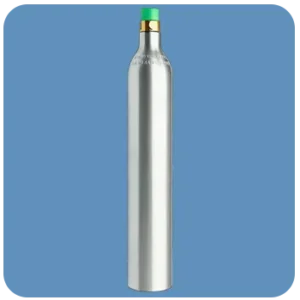
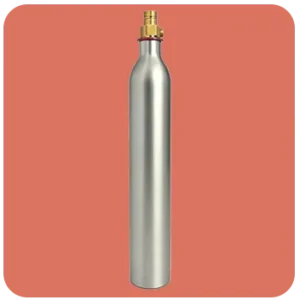
This is where aluminum’s advantage is most dramatic. For a standard 425g capacity CO2 cylinder, an aluminum 6061-T6 unit weighs approximately 770g empty (1170g filled), while a seamless steel equivalent weighs 1200-1400g empty (1600-1800g filled). That is 45-80% heavier for steel.
In practical terms: a pallet of 20GP container holding steel cylinders weighs significantly more, increasing your freight costs by 20-35%. For e-commerce fulfillment where shipping rates are weight-sensitive, this directly erodes margin.
Corrosion Resistance: Aluminum’s Natural Oxide Layer
Steel cylinders require surface treatment (zinc plating, phosphating, or powder coating) to prevent rust — and even then, they’re vulnerable in humid environments, coastal areas, or when exposed to acidic beverages. Aluminum forms a natural oxide layer (Al2O3) that provides inherent corrosion resistance without additional coating.
- Aluminum: Naturally resistant to oxidation. Can be anodized for extra durability and aesthetic options (matte black, teal blue, silver, custom colors).
- Steel: Requires protective coating. If scratched or dented, rust propagates quickly. Not suitable for beverage contact without internal lining.
Pressure Rating & Safety Performance
Both materials can be engineered to meet identical pressure standards, but their behavior under stress differs meaningfully. Aluminum alloy typically handles 180 bar (2611 psi) working pressure with a burst ratio around 2.5x. Steel can reach 180-200 bar with up to 3x burst ratio. The critical difference: aluminum fails ductilely (tears without fragmenting) while certain steel alloys can exhibit more brittle failure modes.
For soda water machine applications where cylinders undergo frequent refill cycling, aluminum’s superior fatigue life means fewer replacements over the product lifetime — a key consideration for subscription-based carbonation services that need 10,000+ cycle durability.
Cost Analysis: Total Cost of Ownership
At face value, steel cylinders appear cheaper — typically 15-25% lower unit price than equivalent aluminum models. But total cost of ownership tells a different story when you factor in shipping costs (heavier steel adds $0.03-$0.08/unit in ocean freight), coating/maintenance requirements (steel needs anti-rust treatment; aluminum needs none), product lifespan (aluminum lasts 30%+ longer in corrosive environments), refill cycle durability (aluminum handles more pressure cycles before fatigue failure), and customer perception (premium feel of aluminum commands higher retail price point).
Bottom line: For B2B wholesale buyers serving premium markets (North America, Western Europe, Japan), aluminum delivers better ROI over a 3-year product lifecycle despite higher initial unit cost.
Application-Specific Recommendations
Beverage Carbonation (Soda Water Machines) — ALUMINUM
No contest here. Beverage-grade purity requirements, frequent consumer interaction, brand aesthetics, and refill cycling all favor aluminum. VS Cylinder’s 425g aluminum CO2 cylinder line is purpose-built for this exact use case with TPED/DOT dual certification.
Medical Oxygen — ALUMINUM (preferred) or Steel
Both materials are acceptable for medical O2 cylinders, but aluminum dominates in portable sizes (M4-M9) due to patient mobility needs. Larger stationary tanks may use steel for cost efficiency. All medical cylinders must carry DOT or ISO 7866 certification regardless of material.
Paintball / PCP Air Tanks — BOTH (application-dependent)
Entry-level paintball often uses steel CO2 tanks for price sensitivity. Competitive/tournament play almost universally uses aluminum HPA tanks for weight advantage and consistency. VS Cylinder offers both lines to serve different market segments.
Industrial / Fire Extinguisher — STEEL (typically)
For industrial applications where aesthetics don’t matter and extreme pressure ratings above 300 bar are needed, steel’s strength-to-weight ratio at very high pressures makes it the pragmatic choice.
Manufacturing Quality Matters More Than Material
A poorly manufactured aluminum cylinder will outperform a well-made steel one — and vice versa. When evaluating suppliers, verify: 100% QC Inspection Rate (not sampling), material traceability via mill certificates for every batch of 6061-T6 aluminum alloy used, ISO 9001 / IATF 16949 certification demonstrating systematic quality management, and third-party testing from independent labs verifying burst pressure, leak rate, and material composition.
Need help deciding? VS Cylinder manufactures both aluminum and steel CO2 cylinders with full customization support. Share your application requirements and target market — we’ll recommend the optimal specification and provide samples for evaluation.